Does Sweating Burn More Fat? What Sweat Really Tells You
Sweating more does not automatically mean you are burning more fat. Learn the difference between water-weight loss and fat loss, why sweat varies, and what to track instead.
Click a star to rate
No. Sweating more does not automatically mean you are burning more body fat.
A drenched shirt can mean you exercised in a hot room, wore extra layers, have become heat-acclimated, or simply sweat more than the person beside you. It does not tell you how much fat you burned.
You may see the scale drop after a sweaty workout, a long walk outdoors, a sauna session, or time in a sweat suit. That short-term drop is mostly body-water loss. Once you drink, eat, and restore fluid, much or all of that weight returns.
That does not mean sweating is bad or that a sweaty workout is useless. Sweat has an important job: it helps cool your body. The useful question is not “How much did I sweat?” It is “Can I repeat this activity often enough, safely enough, and enjoy it enough to support my long-term goals?”
The Short Answer: Sweat Is Cooling, Not a Fat-Loss Score
Your body produces sweat when it needs to release heat. As sweat evaporates from your skin, it helps cool you down.
Exercise can make you sweat because working muscles produce heat. But hot weather, high humidity, heavy clothing, poor airflow, stress, caffeine, and individual biology can also change how much you sweat.
Fat loss is different. It happens over time when your body uses more energy than it takes in. Exercise can contribute to that energy gap, but the amount of sweat you produce is not a reliable way to measure it.
A useful distinction:
- •Sweat loss can change your body weight within minutes or hours.
- •Fat loss is a slower change in body-fat tissue over days and weeks.
- •A hard workout may support fat loss, but its sweat level cannot prove how much fat it used.
If two people do the same 30-minute walk, one might barely sweat in an air-conditioned room while the other sweats heavily outdoors in humid weather. Their shirts may look completely different, but the difference in sweat does not automatically mean the second person lost more fat.
Why the Scale Can Drop After a Sweaty Workout
Sweat is mostly water, along with small amounts of electrolytes such as sodium. When you sweat, you temporarily carry less fluid in your body. A scale detects that lower body mass, but it cannot tell whether the change came from water, food in your digestive system, muscle tissue, or fat tissue.
That is why a lower post-workout weigh-in can feel encouraging but can be misleading.
Imagine this common situation:
- •You weigh yourself before a warm workout.
- •You exercise for 45 minutes and sweat heavily.
- •The scale is lower afterward.
- •You drink water and eat meals as usual.
- •The next morning, your weight is back near where it started.
You did not “gain the fat back” overnight. The first change was mostly fluid. Rehydrating restored water your body needed.
Research on exercise and heat consistently shows that sweat losses are a major part of short-term changes in body mass during activity. Fluid needs can vary greatly with exercise intensity, weather, clothing, and the person. [NIH: Water Requirements During Exercise in the Heat](https://www.ncbi.nlm.nih.gov/books/NBK236237/)
Water Weight and Fat Loss Are Not the Same Thing
It helps to separate these two terms.
Water weight
Water weight refers to short-term changes in body fluid. It can shift because of sweating, salty meals, carbohydrate intake, menstrual-cycle changes, alcohol, travel, illness, or changes in bowel habits.
Water-weight changes can happen quickly. They can move the scale up or down without reflecting a meaningful change in body fat.
Fat loss
Fat loss means a reduction in stored body fat over time. It is not usually dramatic from one day to the next. It is better judged through trends, such as:
- •A rolling average of several morning weigh-ins
- •Waist or clothing-fit changes
- •Strength and fitness progress
- •Consistent habits around food, movement, sleep, and recovery
- •Progress photos, if you find them helpful and emotionally safe
A single sweaty workout can fit into a fat-loss plan. It just should not be treated as proof that fat loss happened because you perspired.
Does Sweating Mean You Burned More Calories?
Not necessarily.
Sweat often rises when your body has more heat to manage. More intense exercise can produce more heat, so a tougher workout may make you sweat more. But the relationship is not simple enough to use sweat as a calorie counter.
For example, you may sweat heavily during a moderate walk in the Philippine heat but sweat much less during a similar walk in cooler weather. The heat changes your cooling needs. It does not turn the walk into a dramatically better fat-loss workout.
Likewise, a person with a higher sweat rate may sweat more than someone doing the same work. That does not mean they are automatically burning more calories.
What affects calorie use more directly includes:
- •How long you are active
- •The intensity and type of activity
- •Your body size
- •How much muscle is involved
- •Your fitness level
- •How consistently you repeat the activity
Even then, calorie estimates from watches, gym machines, and online calculators are estimates. Use them as broad feedback, not as a precise score you must “earn” with sweat.
Does Your Body Burn Fat During Exercise?
Your body can use a mix of carbohydrates and fat to fuel activity. The mix changes with exercise intensity, duration, training status, recent meals, and other factors.
But using some fat as fuel during a workout is not the same thing as losing measurable body fat from your body. Long-term body-fat change is shaped by your overall energy balance and habits across many days and weeks.
This is why people can complete very sweaty sessions and still see little fat-loss progress if the routine is too exhausting to sustain, drives intense hunger, disrupts sleep, or is paired with an eating pattern that does not fit their goal.
The best workout for fat loss is rarely the one that leaves the biggest puddle on the floor. It is usually the one you can recover from and repeat.
Why You Sweat More on Some Days Than Others
A sudden change in sweating can make people think their workout is working better. Often, the explanation is simpler.
Heat and humidity
Hot weather increases the need to release heat. Humidity can make evaporation less effective, so sweat may stay on your skin and clothes instead of evaporating. You may look much sweatier without doing more work.
Clothing and airflow
Dark, heavy, tight, or non-breathable clothing can trap heat. A poorly ventilated room can do the same. More sweat under those conditions does not mean a better workout.
Exercise intensity
Harder activity often creates more heat, so it can increase sweating. Still, one person’s “very sweaty” workout may be another person’s modest sweat session. Use effort, duration, and recovery—not sweat alone—to judge intensity.
Fitness and heat acclimation
With repeated exposure to heat, the body can adapt. Some trained or heat-acclimated people begin sweating sooner or more efficiently. That can be a normal cooling adaptation, not proof of greater fat loss.
Individual differences
Body size, genetics, hormones, medications, hydration status, and health conditions can affect sweating. Some people simply sweat more or less than others.
Is a Sweaty Workout Still a Good Workout?
It can be. Sweat is not the enemy. It is a normal response that helps control body temperature.
A workout is useful when it matches your current fitness, feels safe, and supports a routine you can continue. That may be a brisk walk, cycling, resistance training, dance, swimming, a home workout, or a mix of activities.
Instead of asking, “Did I sweat enough?” try these questions:
- •Did this workout challenge me at a reasonable level?
- •Can I recover and do it again this week?
- •Am I gradually building fitness, strength, walking time, or confidence?
- •Do I have enough energy to keep my daily routine going?
- •Am I tracking progress over weeks rather than one sweaty session?
Those questions are far more useful for fat loss than how wet your clothes are.
A Better Way to Choose Workouts for Fat Loss
For beginner health-conscious adults, the most effective routine is usually built around consistency instead of punishment.
Start with activity you can repeat
Walking is a strong starting point because it is simple, low cost, and easy to scale. You can begin with 10 to 20 minutes, then slowly add time, pace, hills, or extra days.
If walking is not enjoyable or practical, consider cycling, low-impact home workouts, dancing, swimming, or beginner strength training.
Include resistance training when possible
Resistance training can help preserve or build muscle while you lose weight. It does not need to leave you soaked to be productive.
A basic routine using body weight, resistance bands, or dumbbells can focus on movements such as squats or chair stands, rows, presses, hinges, and carries. Start with a level you can perform with good control.
Use effort, not sweat, to guide you
For moderate activity, you should generally be able to speak in short sentences but not sing comfortably. For harder activity, speaking becomes more difficult.
This is not a perfect tool, but it is more informative than the amount of sweat on your shirt.
Build the habit before chasing intensity
A short walk completed five days a week often does more for long-term progress than an extreme sweat session you quit after one week.
You can make workouts harder later. First, create a routine that fits your schedule, joints, fitness level, and recovery.
Do Saunas Burn Fat?
A sauna can make the scale go down temporarily because you lose fluid through sweat. That is not the same as meaningful fat loss.
Passive heat exposure may raise heart rate and energy expenditure somewhat, but it does not replace regular movement, resistance training, or a sustainable eating pattern. It also should not be used as a dehydration tool.
If you enjoy a sauna and can use it safely, treat it as relaxation or a personal routine—not as a shortcut to fat loss. Avoid claims that a sauna “melts fat,” “detoxes fat,” or selectively reduces belly fat. Those claims go beyond what the evidence can support.
A study of sauna bathing notes that short-term body-mass reductions are tied to fluid loss. [PMC: Effects of Twelve Sessions of High-Temperature Sauna Baths](https://pmc.ncbi.nlm.nih.gov/articles/PMC8122786/)
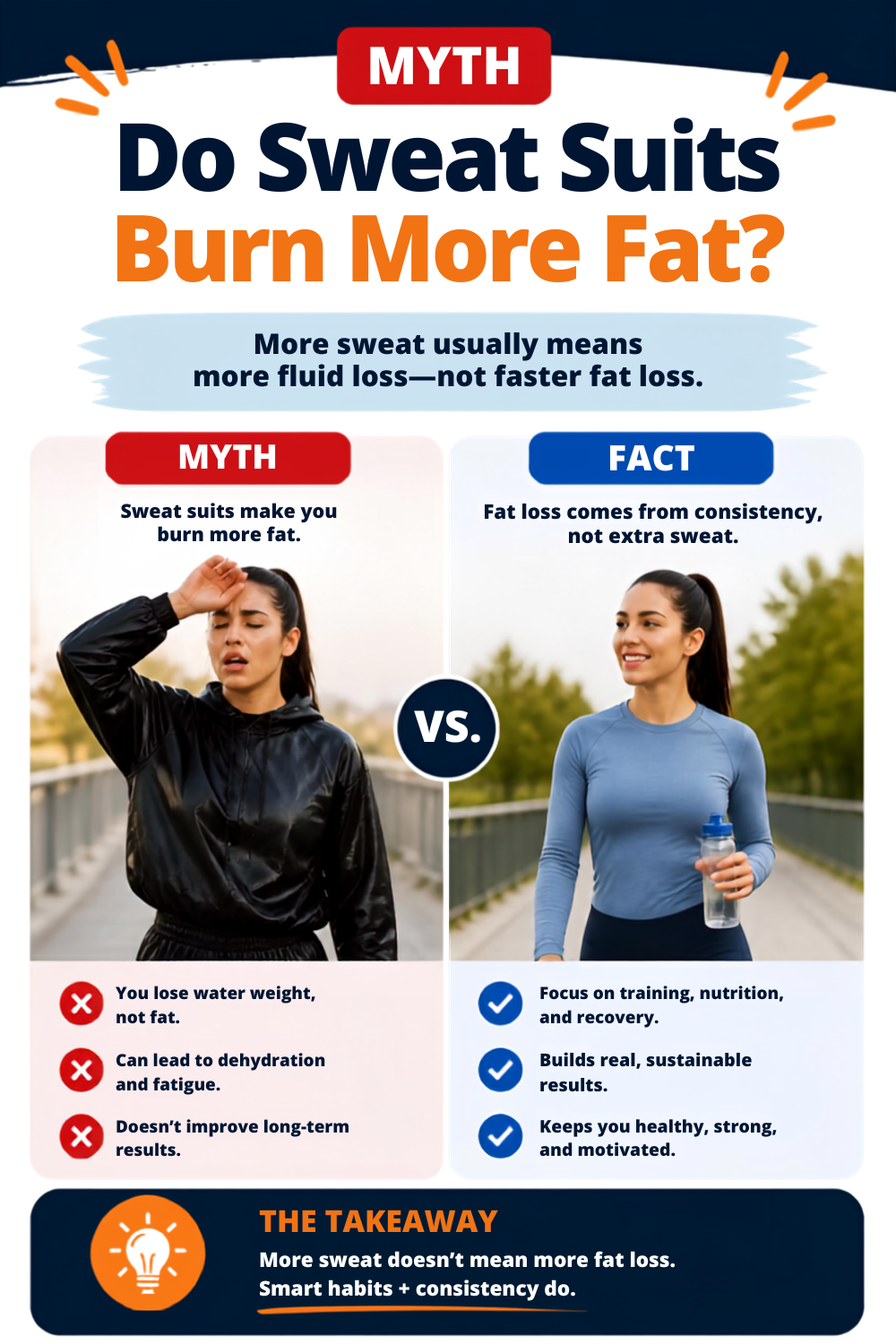
Do Sweat Suits Help You Lose More Fat?
Sweat suits and extra layers can make you sweat more by trapping heat. They may lower scale weight quickly through fluid loss, but they do not make that rapid loss equal fat loss.
They can also make exercise more uncomfortable and raise heat-related risk, especially in hot or humid conditions. For most people, they are not needed for a productive workout.
If a product promises fat loss because it makes you sweat, be skeptical. A product can change how much you perspire without changing the fundamentals of body-fat loss.
How to Track Progress Without Being Fooled by Sweat
If fat loss is your goal, create a consistent check-in routine.
Weigh under similar conditions
If you choose to use a scale, weigh at roughly the same time of day, ideally after using the bathroom and before eating or drinking. Avoid comparing a pre-workout weight with a post-workout weight as if they measure fat loss.
Look at averages, not one number
Daily body weight can move for many reasons. A seven-day average or a weekly trend gives a clearer picture than reacting to every increase or decrease.
Track a second signal
Choose one additional measure, such as waist circumference, how a pair of trousers fits, a walking pace, the number of strength-training repetitions you can complete, or your energy during the day.
Give your plan enough time
A useful habit change needs time to show up. Review your routine after several weeks, not after one hot workout.
Common Mistakes to Avoid
Trying to sweat on purpose
Turning up the heat, wearing extra layers, or avoiding fluids may produce a dramatic scale change. It does not create a reliable fat-loss advantage and can make exercise less safe.
Treating sweat as proof of effort
Some excellent workouts produce little visible sweat. Strength training in a cool room, a walk in cooler weather, or a technically focused session can still support your goal.
Drinking less to stay “lighter”
Dehydration is not progress. You need fluid for normal body function and exercise performance. Drink more when you are at higher risk of dehydration, including when exercising or sweating in hot weather. [NHS: Dehydration](https://www.nhs.uk/conditions/dehydration/)
Replacing a sustainable routine with extreme sessions
A workout plan should make your life more workable, not leave you dreading movement. Increase difficulty gradually and choose activities you can keep doing.
When Heat and Sweating Need Extra Caution
Most sweating during exercise is normal. However, do not push through warning signs of overheating or dehydration.
Stop exercising, get somewhere cooler, and rehydrate if you feel faint, confused, unusually weak, nauseated, develop a severe headache, or feel unable to continue safely. Seek urgent medical help for severe symptoms, loss of consciousness, chest pain, or symptoms that do not improve.
People who are pregnant, have heart, kidney, or heat-related conditions, use medications that affect fluid balance or temperature regulation, or have been advised to limit fluid or salt intake should ask a qualified clinician for personal guidance before using heat exposure or intense exercise strategies.
Frequently Asked Questions
Does sweating burn fat from your belly?
No. Sweat does not target belly fat or any other body area. Where your body stores and loses fat is influenced by many factors, including genetics and overall body-fat change. Spot reduction claims are misleading.
Why do I weigh less after a workout?
You may have lost fluid through sweat and breathing, and you may have less food or fluid in your digestive system. That quick change is not a reliable measure of fat loss.
Is it bad if I do not sweat much during exercise?
Not necessarily. Sweat rate differs between people and conditions. Focus on your effort, comfort, progress, and hydration. If you have a sudden, unusual inability to sweat in the heat or concerning symptoms, discuss it with a clinician.
Does sweating more mean you are fitter?
Not on its own. Heat acclimation and fitness can affect sweating, but sweat rate also varies with temperature, clothing, hydration, and the individual. It is not a standalone fitness test.
Should I drink water during a workout?
For many people, drinking according to thirst and replacing fluids after exercise is practical. You may need more fluid during longer sessions, high heat, heavy sweating, or when you have specific medical or sports-performance needs.
Does exercising in hot weather burn more fat?
Hot weather may make a workout feel harder and increase sweat loss, but it is not a dependable fat-loss strategy. Choose a safe intensity, protect yourself from heat, and prioritize consistency.
The Bottom Line
Sweating is your body's cooling system, not a measure of how much fat you burned.
A sweaty workout can be part of a healthy fat-loss routine, but the sweat itself is mostly a sign that your body is managing heat and losing fluid. The scale drop right after exercise is usually water weight, not a dramatic change in body fat.
Choose movement you can repeat, build your fitness gradually, stay hydrated, and judge progress through long-term trends. A comfortable walk you do regularly can be more valuable than a punishing sweat session you cannot sustain.
Sources
- •National Academies / NIH. [Water Requirements During Exercise in the Heat](https://www.ncbi.nlm.nih.gov/books/NBK236237/)
- •NHS. [Dehydration](https://www.nhs.uk/conditions/dehydration/)
- •Toro V, et al. [Effects of Twelve Sessions of High-Temperature Sauna Baths](https://pmc.ncbi.nlm.nih.gov/articles/PMC8122786/)
- •Wewege M, et al. [HIIT versus moderate-intensity continuous training for body composition: systematic review and meta-analysis](https://pubmed.ncbi.nlm.nih.gov/28401638/)
Comments (0)
Share your thoughts and experiences
No comments yet. Be the first to share your thoughts!