
How Mobility Training Improves Performance: Evidence-Based Guide for Better Movement, Workouts, and Long-Term Fitness
Discover how mobility training improves movement quality, exercise performance, joint function, and workout consistency. Learn the science, common myths, beginner routines, and practical strategies in this evidence-based guide.
Click a star to rate

Mobility training has become one of the most discussed topics in fitness, yet it remains one of the most misunderstood.
Many people assume mobility training is simply stretching. Others believe it is only useful for athletes, yoga practitioners, or people recovering from injuries.
The reality is very different.
Mobility training is a practical skill that helps people move more efficiently, perform exercises with better technique, and maintain healthy movement throughout life.
For beginners focused on fat loss and overall health, mobility may be one of the most overlooked tools for creating a sustainable fitness routine.
While mobility training does not directly burn large numbers of calories, it can help support the activities that do. Moving comfortably often makes it easier to walk, strength train, stay active, and remain consistent with exercise over time.
Current exercise science supports mobility-focused movement as an important component of a well-rounded fitness program.
Quick Answer
Mobility training improves performance by helping joints move through their available range of motion with strength, stability, and control.
Better mobility may help:
- •Improve movement quality
- •Support exercise technique
- •Enhance squat, lunge, and overhead movement mechanics
- •Improve warm-up effectiveness
- •Increase confidence during exercise
- •Support long-term joint health
- •Reduce movement restrictions caused by prolonged sitting
Mobility training works best when combined with strength training, cardiovascular exercise, adequate recovery, and healthy lifestyle habits.
Key Takeaways
- •Mobility is different from flexibility.
- •Mobility combines movement, control, strength, and stability.
- •Most adults can benefit from mobility exercises.
- •Dynamic mobility exercises are commonly used before workouts.
- •Better mobility may support exercise technique and movement efficiency.
- •Consistency matters more than complexity.
- •Beginners can start with five to ten minutes daily.
- •Mobility training supports healthy aging and long-term physical function.
What Is Mobility Training?
Mobility training refers to exercises designed to improve how well a joint moves while maintaining active control throughout the movement.
Unlike passive stretching, mobility requires participation from the muscles, nervous system, and joints.
Think of mobility as usable movement.
A person may be flexible enough to touch their toes but still lack the mobility needed to perform a deep squat comfortably.
Mobility focuses on movement that can actually be applied during exercise and everyday life.
Examples include:
- •Hip mobility drills
- •Shoulder mobility exercises
- •Thoracic spine rotations
- •Ankle mobility movements
- •Controlled articular rotations
- •Dynamic warm-up exercises
The goal is not simply to move farther.
The goal is to move better.
Mobility vs Flexibility
One of the biggest sources of confusion in fitness is the difference between mobility and flexibility.
Although the terms are often used interchangeably, they are not the same.
Flexibility
Flexibility refers to the ability of a muscle to lengthen.
Examples include:
- •Touching your toes
- •Performing a hamstring stretch
- •Holding a calf stretch
Flexibility is primarily about tissue length.
Mobility
Mobility refers to the ability to actively move a joint through its available range of motion with control.
Mobility includes:
- •Flexibility
- •Strength
- •Stability
- •Coordination
- •Balance
- •Neuromuscular control
Because mobility includes several physical qualities, improving mobility often requires more than simply stretching.
Why Mobility Matters for Everyday Life
Many people associate mobility training with sports performance.
However, mobility may be even more important for ordinary daily activities.
Simple actions rely on adequate mobility:
- •Getting up from a chair
- •Walking up stairs
- •Reaching overhead
- •Picking objects up from the floor
- •Carrying groceries
- •Getting in and out of a vehicle
When mobility becomes limited, these tasks often become more difficult.
Over time, reduced movement quality may contribute to a more sedentary lifestyle.
This is especially relevant because modern lifestyles encourage prolonged sitting.
Hours spent at desks, in vehicles, and in front of screens can reduce movement variability throughout the day.
The result is often:
- •Tight hips
- •Stiff ankles
- •Limited thoracic rotation
- •Reduced shoulder movement
- •Poor posture habits
Mobility training helps reintroduce movement into areas that may not receive enough regular activity.
How Mobility Training Improves Performance
Performance does not only mean athletic competition.
For beginners, performance can mean:
- •Walking comfortably
- •Exercising with confidence
- •Completing workouts efficiently
- •Maintaining proper technique
- •Reducing movement limitations
Mobility training may contribute to each of these goals.
1. Improves Movement Quality
Movement quality refers to how efficiently and effectively the body performs a task.
Exercises such as squats, lunges, deadlifts, push-ups, and overhead presses require multiple joints to work together.
If one joint lacks mobility, the body often compensates elsewhere.
For example:
- •Limited ankle mobility may affect squat mechanics.
- •Limited hip mobility may change movement patterns during lunges.
- •Limited shoulder mobility may affect overhead movements.
Improving mobility can help support healthier movement strategies during exercise.
2. Supports Better Exercise Technique
Good exercise technique depends on the ability to reach positions safely and comfortably.
Many common movement problems are not caused by lack of effort.
Instead, they may result from limitations in mobility.
For example:
A person may struggle to keep their chest upright during a squat because their ankles or hips cannot move adequately through the required range.
Mobility exercises may help address these limitations while allowing strength training to reinforce improved movement patterns.
3. Helps Warm Up the Body for Activity
Research consistently supports dynamic movement before exercise.
Unlike prolonged static stretching immediately before activity, dynamic mobility exercises actively prepare muscles and joints for movement.
Benefits of mobility-focused warm-ups may include:
- •Increased body temperature
- •Improved circulation
- •Greater movement readiness
- •Enhanced neuromuscular activation
- •Better exercise preparation
Common warm-up mobility exercises include:
- •Leg swings
- •Hip circles
- •Arm circles
- •World's Greatest Stretch
- •Thoracic rotations
- •Walking lunges
Evidence Summary
Current evidence generally supports mobility and dynamic movement as useful components of warm-up routines and movement preparation.
Research has shown that dynamic warm-ups often improve movement readiness more effectively than prolonged passive stretching before activities requiring strength, power, or athletic performance.
However, mobility training should not be viewed as a stand-alone solution.
The greatest benefits typically occur when mobility work is combined with: - Progressive strength training - Regular cardiovascular exercise - Appropriate recovery - Consistent physical activity - Individualized exercise programming
Rather than replacing other forms of exercise, mobility training complements them.
4. Supports Better Range of Motion
Range of motion describes how far a joint can move.
Healthy range of motion is important because many daily activities require joints to move through comfortable, controlled positions.
Examples include:
- •Reaching overhead to place an item on a shelf
- •Sitting into a chair
- •Climbing stairs
- •Getting up from the floor
- •Walking with a natural stride
Mobility exercises encourage active movement throughout these ranges while emphasizing muscular control.
For many beginners, improved range of motion can make common exercises feel less restricted and more comfortable.
5. Builds Active Stability
Mobility is not simply about moving farther.
Equally important is the ability to control movement.
Active stability refers to maintaining joint control throughout motion.
For example:
Someone may have enough flexibility to perform a deep squat passively but lack the strength and coordination to maintain proper alignment while performing the movement under load.
Mobility drills frequently combine movement with muscular activation, helping develop control rather than flexibility alone.
6. Improves Body Awareness
Body awareness, sometimes called proprioception, is the ability to recognize where your body is in space.
Better body awareness can make exercise technique easier to learn because people become more aware of:
- •Joint positioning
- •Balance
- •Weight distribution
- •Posture
- •Movement efficiency
Many mobility exercises require slow, deliberate movement, encouraging greater awareness of how the body moves.
This can be especially valuable for beginners who are still learning basic exercise patterns.
7. May Support Long-Term Joint Health
Healthy joints depend on regular movement.
Although mobility training cannot prevent all joint problems or eliminate existing conditions, regular movement may help maintain comfortable joint function throughout adulthood.
Movement also helps nourish joint cartilage through the normal exchange of nutrients that occurs during activity.
This is one reason healthcare and exercise organizations encourage regular physical activity across the lifespan.
Who Can Benefit Most From Mobility Training?
Nearly everyone can benefit from improving movement quality, but certain groups often experience noticeable improvements.
Office Workers
Long periods of sitting may contribute to:
- •Tight hip flexors
- •Reduced thoracic mobility
- •Stiff shoulders
- •Limited ankle movement
A short daily mobility routine may help offset some of the movement limitations associated with prolonged sitting.
Beginners Starting Exercise
Many beginners feel discouraged because exercises feel awkward.
Sometimes the issue is not strength.
It is movement quality.
Learning mobility alongside strength exercises often makes foundational movements easier to perform.
Adults Over 40
Natural age-related changes can influence joint mobility and muscle function.
Remaining physically active while including mobility work may help support independence and functional movement later in life.
Recreational Exercisers
Whether someone enjoys walking, cycling, resistance training, hiking, or group fitness classes, mobility exercises can be incorporated into nearly any fitness routine.
Common Signs Your Body May Need More Mobility
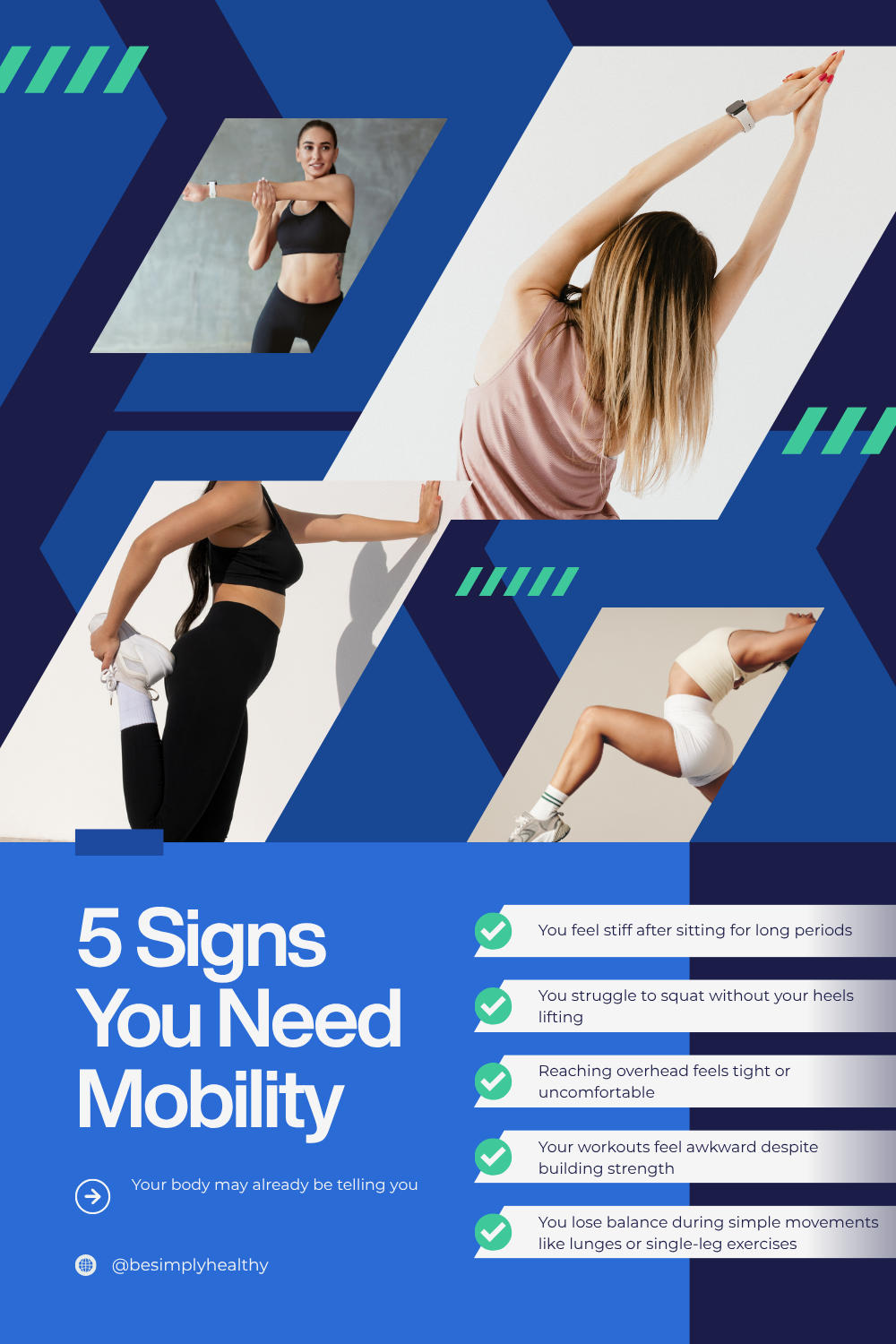
Everyone has different movement abilities.
However, these common signs may suggest mobility deserves more attention.
You Feel Stiff After Sitting
Remaining in one position for extended periods often leaves joints feeling less comfortable.
Standing up and moving may initially feel difficult until the body loosens up.
Squats Feel Difficult
Difficulty reaching comfortable squat depth may relate to mobility limitations in the ankles, hips, or thoracic spine.
Reaching Overhead Feels Restricted
Limited shoulder mobility may make reaching cabinets or performing overhead exercises feel challenging.
You Frequently Lose Balance
Balance depends on several systems, including mobility, strength, coordination, and sensory feedback.
Poor mobility may contribute to movement compensation that affects stability.
Certain Exercises Never Feel Comfortable
If exercises consistently feel awkward despite proper coaching, mobility limitations may be worth evaluating.
Common Mobility Myths
Myth 1: Mobility Is Just Stretching
Fact:
Stretching is one component of movement, but mobility also requires muscular strength, stability, coordination, and active control.
Myth 2: Mobility Is Only for Athletes
Fact:
Everyday activities require mobility.
Walking, climbing stairs, carrying groceries, and getting off the floor all depend on healthy movement.
Myth 3: More Stretching Always Means Better Mobility
Fact:
Longer muscles do not automatically produce better movement.
Mobility improvements often require strengthening muscles throughout the available range of motion.
Myth 4: Mobility Training Eliminates Injury Risk
Fact:
No exercise guarantees injury prevention.
Injury risk depends on many factors including training load, previous injuries, sleep, recovery, overall conditioning, and exercise technique.
Mobility is one helpful component of a comprehensive exercise program rather than a guaranteed protective strategy.
Myth 5: Mobility Takes Too Much Time
Fact:
Many beginners can complete an effective mobility routine in approximately five to ten minutes before exercise.
Consistency is generally more important than duration.
Beginner Mobility Routine
The following routine requires no equipment and can be completed in about eight to ten minutes.
Cat-Cow
Purpose:
Improve movement through the spine.
Perform:
8–10 slow repetitions.
World's Greatest Stretch
Purpose:
Improve hip, thoracic spine, and hamstring mobility.
Perform:
5 repetitions per side.
Hip Circles
Purpose:
Encourage comfortable hip movement.
Perform:
10 circles each direction.
Thoracic Rotations
Purpose:
Improve upper-back mobility for posture and overhead movement.
Perform:
8 repetitions per side.
Ankle Rocks
Purpose:
Support comfortable squat mechanics.
Perform:
10 repetitions per ankle.
Shoulder Circles
Purpose:
Prepare the shoulders before upper-body exercise.
Perform:
20 controlled repetitions.
Deep Squat Hold
Purpose:
Practice comfortable squat positioning while maintaining control.
Perform:
Hold for 20–30 seconds while breathing normally.
When Should You Do Mobility Training?
Mobility exercises can fit into several parts of the day.
Before Workouts
Dynamic mobility exercises are commonly included in warm-ups to prepare the body for movement.
After Exercise
Gentle mobility work may be included during cool-downs if it feels comfortable.
During Work Breaks
Short movement breaks can help interrupt long periods of sitting.
Morning Routine
Many people enjoy mobility exercises shortly after waking to reduce feelings of stiffness before beginning daily activities. ## Mobility and Weight Loss: Is There a Connection?
Mobility training is not a high-calorie-burning activity like brisk walking, cycling, or resistance training.
However, it can still play an important supporting role in a weight management plan.
Better mobility may help people:
- •Exercise more comfortably
- •Improve movement confidence
- •Perform strength exercises with better technique
- •Stay physically active more consistently
- •Reduce movement limitations caused by prolonged sitting
For example, someone who struggles to squat because of limited ankle or hip mobility may avoid lower-body strength training altogether.
Improving mobility can make these exercises feel more accessible, allowing the individual to participate more consistently in a well-rounded fitness program.
Long-term weight management is built on sustainable habits.
Mobility training supports those habits by making movement feel more comfortable rather than acting as a standalone weight-loss strategy.
Mobility and Healthy Aging
Maintaining mobility becomes increasingly important with age.
Natural changes in muscles, connective tissues, and joints can gradually reduce movement capacity if physical activity declines.
Remaining active throughout adulthood helps preserve functional independence.
Good mobility supports everyday tasks such as:
- •Walking longer distances
- •Climbing stairs
- •Carrying groceries
- •Getting up from the floor
- •Playing with children or grandchildren
- •Participating in recreational activities
Exercise organizations consistently encourage adults to include activities that promote strength, balance, flexibility, and functional movement as part of lifelong health.
Mobility training fits naturally into this broader approach.
Common Mistakes Beginners Make
Improving mobility does not require complicated routines.
Avoiding a few common mistakes can make your efforts more productive.
Mistake 1: Only Stretching Tight Muscles
Many people repeatedly stretch muscles they perceive as tight.
Sometimes the issue is not muscle length.
Limited strength, poor movement control, or reduced stability may contribute just as much.
Mobility exercises address these qualities together rather than focusing only on passive stretching.
Mistake 2: Skipping Warm-Ups
Beginning intense exercise without preparing the body may leave movements feeling stiff or uncomfortable.
A short dynamic warm-up can help transition from rest to activity.
Mistake 3: Moving Too Quickly
Mobility exercises should be controlled.
Slow, deliberate repetitions allow you to focus on movement quality rather than speed.
Mistake 4: Expecting Immediate Results
Meaningful improvements usually occur gradually.
Consistency over weeks and months is more realistic than expecting dramatic changes after a single session.
Mistake 5: Ignoring Strength Training
Mobility and strength work together.
Strength helps maintain control throughout the ranges of motion developed through mobility practice.
Practical Tips for Building a Daily Mobility Habit
Many beginners struggle because they try to overhaul their entire routine at once.
Instead, build mobility into habits you already have.
Try these ideas:
- •Perform five minutes of mobility before every workout.
- •Complete a short routine after long periods of sitting.
- •Pair mobility with your morning coffee.
- •Keep a yoga mat visible as a reminder.
- •Schedule movement breaks during work.
- •Follow a simple weekly checklist instead of chasing perfection.
The goal is consistency—not complexity.
Sample Weekly Beginner Mobility Plan
Monday
- •Hip mobility
- •Thoracic rotations
- •Shoulder circles
Tuesday
- •Ankle mobility
- •Deep squat holds
- •Cat-Cow
Wednesday
Repeat Monday's routine.
Thursday
Repeat Tuesday's routine.
Friday
Combine all exercises into a ten-minute session.
Saturday
Complete your mobility routine before a walk or strength workout.
Sunday
Use gentle mobility exercises as active recovery.
This schedule can easily be adjusted based on your preferences, available time, and fitness goals.
Mobility Equipment Worth Considering
Most mobility exercises require no equipment.
However, a few inexpensive tools may add variety.
Examples include:
- •Resistance loop bands
- •Long resistance bands
- •Foam rollers
- •Massage balls
- •Yoga mats
- •Cork blocks
- •Exercise benches
Equipment is optional.
Learning proper movement patterns matters much more than buying accessories.
Frequently Asked Questions
Should I Do Mobility Every Day?
For most healthy adults, gentle daily mobility exercises are generally appropriate.
Intensity should match your activity level and any medical guidance you have received.
How Long Should a Mobility Session Last?
Many beginners benefit from sessions lasting five to ten minutes.
Longer sessions may be appropriate depending on your goals and training program.
Can Mobility Replace Stretching?
Not entirely.
Stretching and mobility each have appropriate uses.
Mobility emphasizes active movement and control, while stretching primarily targets muscle length.
Is Mobility Training Safe?
Most basic mobility exercises are considered low risk when performed with good technique and within a comfortable range of motion.
If you have significant pain, recent injuries, or medical conditions affecting movement, consult an appropriate healthcare professional before beginning a new exercise routine.
How Soon Will I Notice Improvements?
Everyone responds differently.
Some people notice movement feels smoother within a few sessions, while more meaningful changes in mobility often require several weeks of consistent practice.
Evidence Summary
Current evidence from sports medicine research and exercise guidelines supports several important conclusions.
Well-designed dynamic warm-ups can improve movement readiness before physical activity.
Mobility training can support movement quality and exercise technique when combined with progressive strength training.
Regular physical activity remains one of the strongest evidence-based strategies for maintaining long-term physical function and healthy aging.
Current evidence does not support exaggerated claims that mobility training alone prevents injuries, eliminates pain, or dramatically improves athletic performance without appropriate training.
Instead, mobility should be viewed as one valuable component of a comprehensive fitness program.
Key Takeaways
- •Mobility is active movement with strength, stability, and control.
- •Flexibility contributes to mobility but does not fully define it.
- •Better mobility may improve movement quality and exercise confidence.
- •Dynamic mobility exercises are commonly included in warm-up routines.
- •Five to ten minutes of consistent practice is an excellent starting point for beginners.
- •Mobility complements strength training, cardiovascular exercise, and healthy lifestyle habits.
- •Consistency produces greater long-term benefits than occasional long sessions.
Conclusion
Mobility training is not about performing advanced stretches or becoming extraordinarily flexible.
It is about moving through life with greater confidence, control, and comfort.
Whether your goal is losing weight, improving exercise technique, reducing stiffness after long workdays, or maintaining independence as you age, mobility deserves a place in your weekly routine.
The best part is that getting started does not require expensive equipment or hours of practice.
A few minutes of consistent movement performed most days of the week can gradually improve how your body feels during everyday activities and workouts.
Rather than viewing mobility as an optional extra, think of it as the foundation that helps every other form of exercise work more effectively.
Continue Learning
Looking for more science-backed fitness resources?
Explore our beginner guides on:
- •Dynamic warm-up routines
- •Resistance training for fat loss
- •Walking for weight management
- •Healthy recovery strategies
- •Functional fitness for beginners
Build your knowledge one healthy habit at a time.
Comments (0)
Share your thoughts and experiences
No comments yet. Be the first to share your thoughts!